Exports are growing, but slower GDP forecasts and a strained credit market are keeping confidence in check. In Phnom Penh housing, affordable launches carry the volume while luxury rents and asking prices face a tougher test.
Based on the Q3 2026 Market Pulse presentation and its 7 October 2026 webinar. This article covers the economy and residential market only.
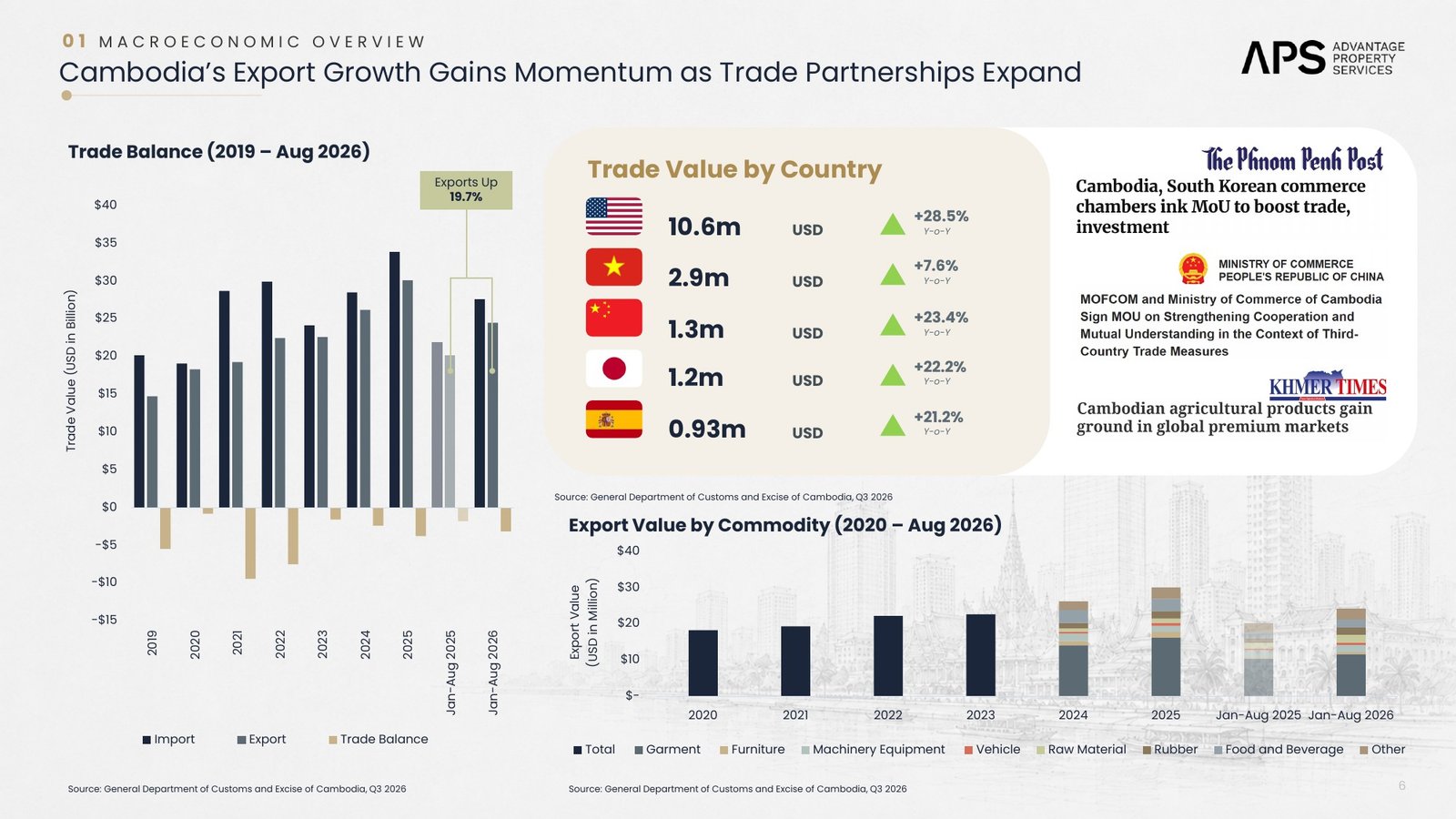
- Exports: +19.7% – January to August 2026, year on year.
- GDP outlook: 3.9% – 2026 World Bank forecast shown in the deck.
- Average NPL ratio: 9.6% – as of June 2026.
- New condo supply: 2,700+ units – completed in Q3 2026.
Section 1 – Economic Overview
The external trade story is improving faster than the domestic credit story. That split helps explain why activity continues, but buyers and developers remain selective.
Export momentum meets a slower growth forecast
Cambodia’s exports rose 19.7% year on year in January to August 2026, according to the customs data in the presentation. Garments remain the main export category, while the webinar also pointed to growth in machinery, equipment and raw materials. The United States remains the country’s largest export destination; the presenter described its year-on-year increase as close to 30%.
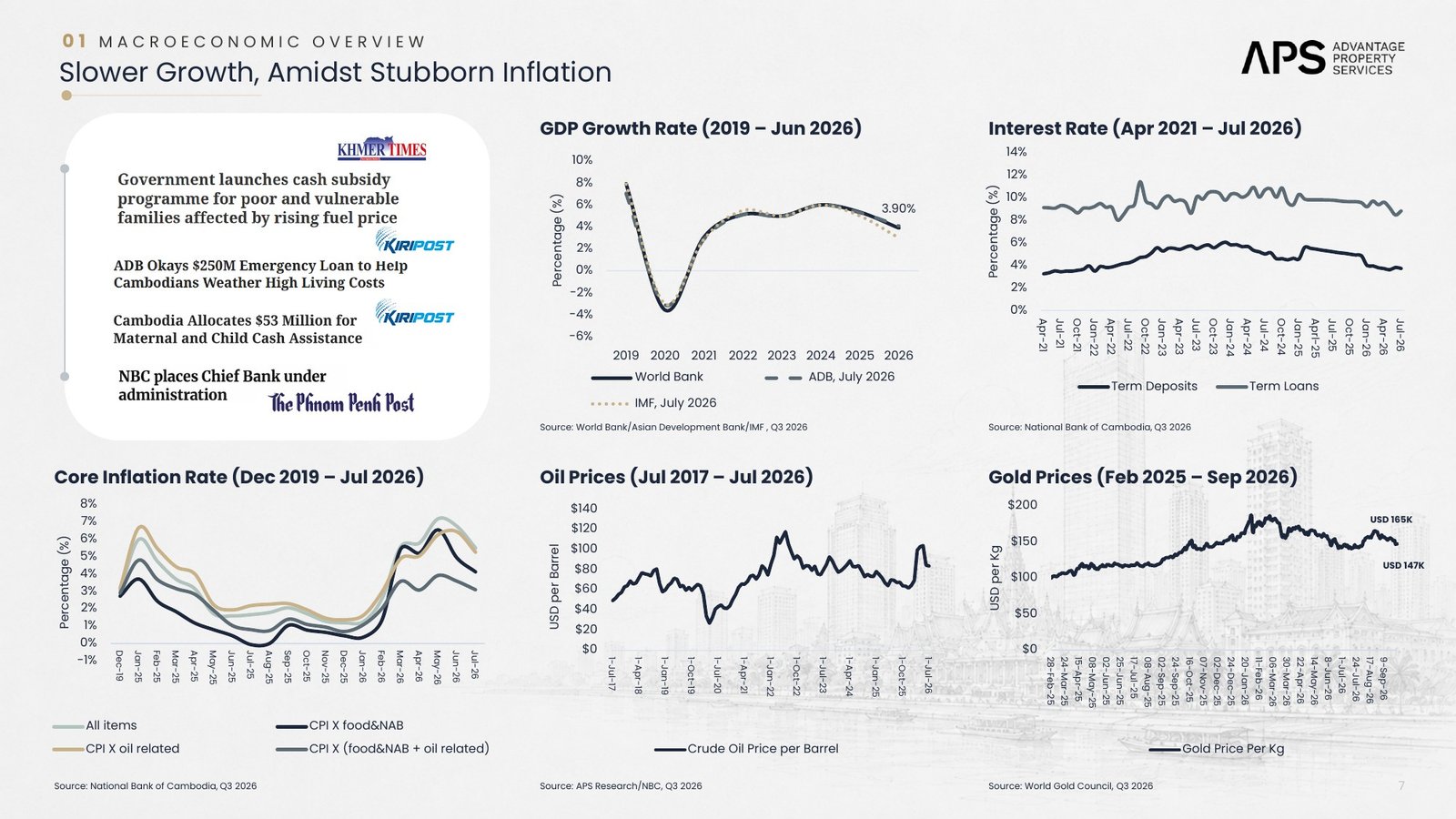
That strength has not removed the broader slowdown. The presentation shows a 3.9% World Bank growth forecast for 2026; the speaker put recent IMF and ADB forecasts in a roughly 3.7% to 3.9% range. Oil costs and inflation add pressure to household purchasing power, even as quoted bank lending rates have moved down from 2025 levels.
Credit quality is the more immediate property constraint
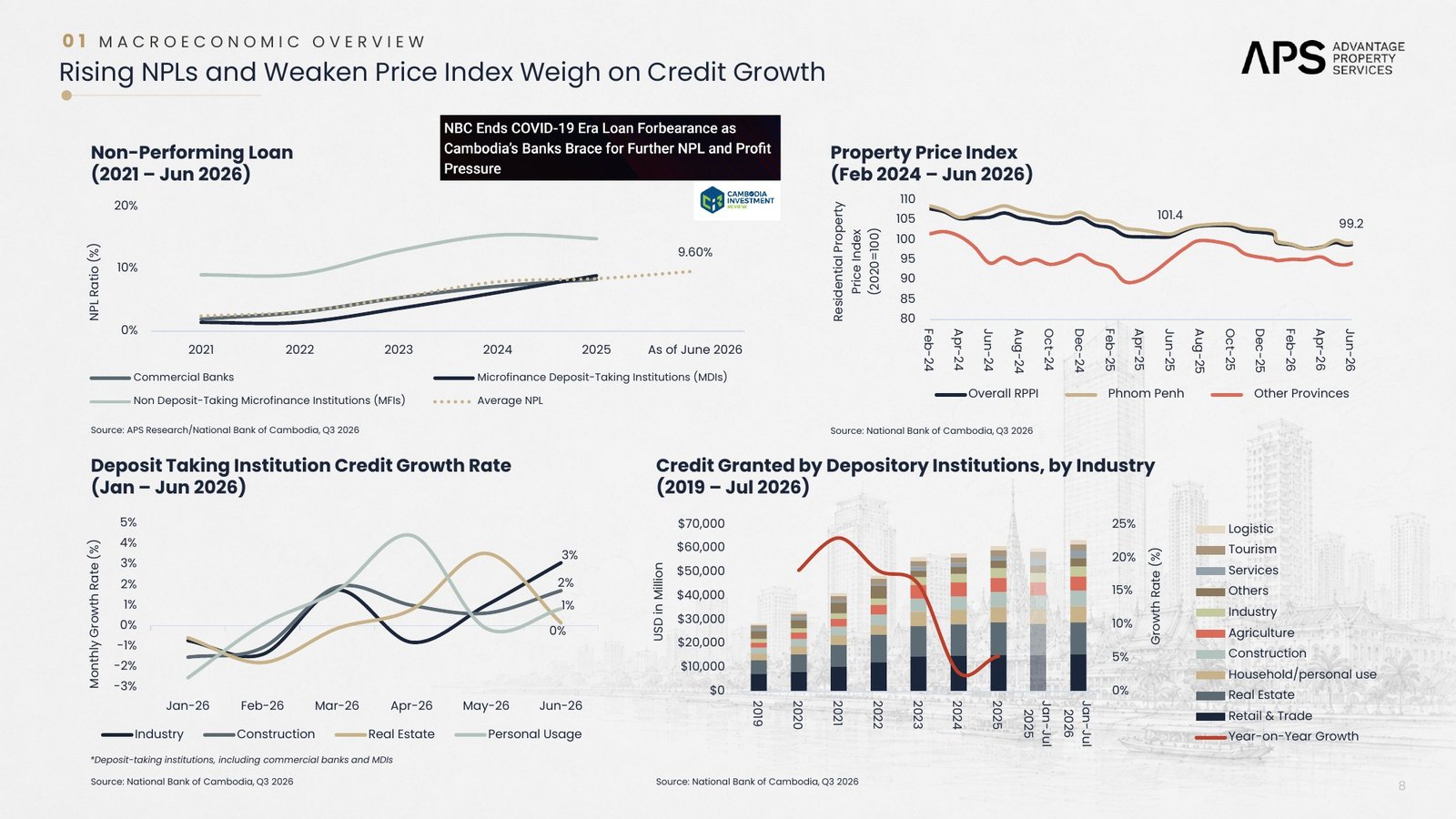
The deck puts the average non-performing loan ratio at 9.6% as of June 2026. Its residential property price index stood at 99.2 in June on a 2020 = 100 basis. Together, these charts describe a market where weaker collateral values and loan quality can make lenders more cautious.
With COVID-era loan restructuring ending, more troubled loans may be recognised as non-performing. That is a forward-looking risk discussed in the webinar, rather than a reported rise already captured in the June figure. For housing, the practical effect is that lower advertised interest rates need not mean easier access to a mortgage.
Investment approvals are still coming through
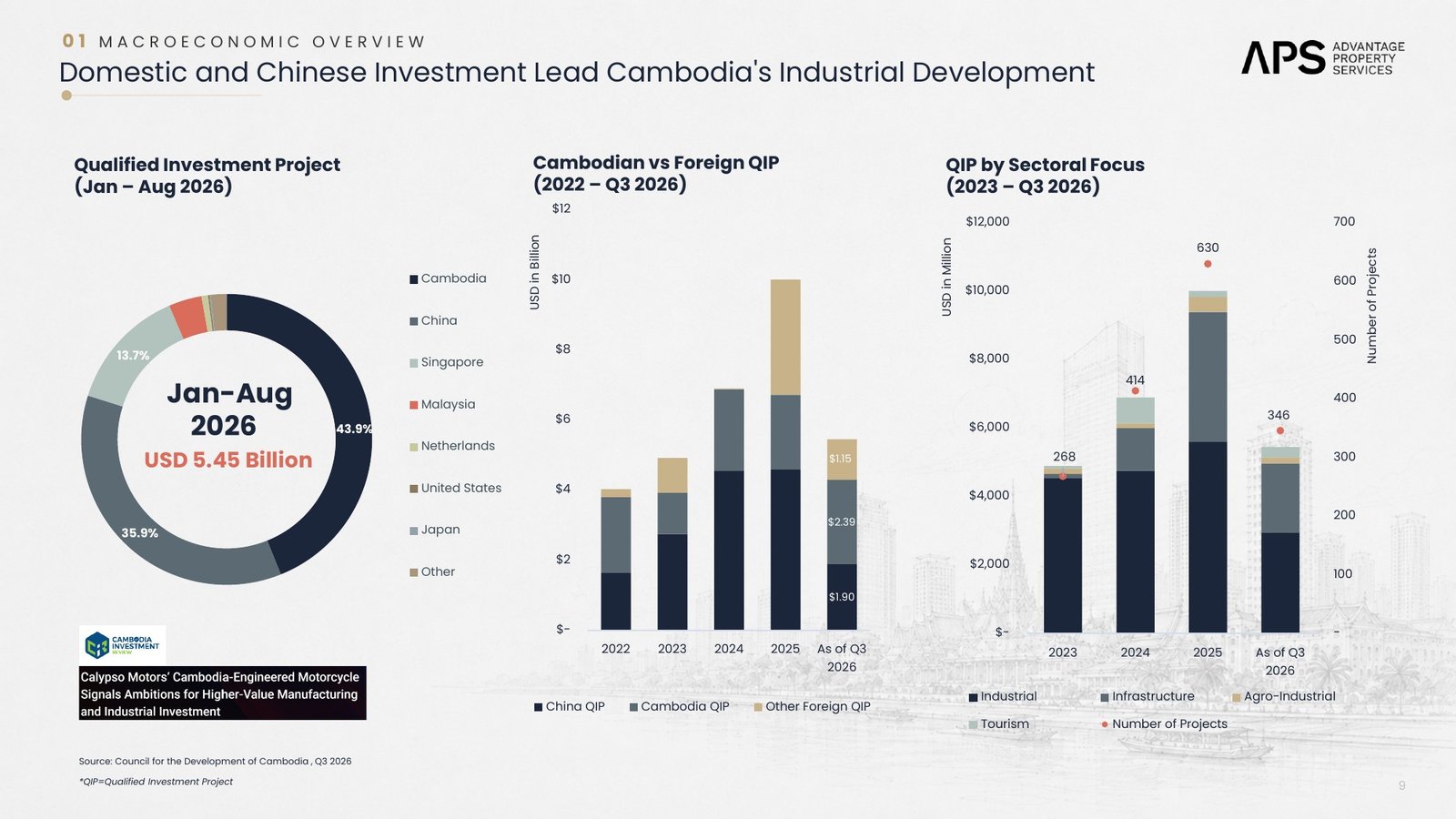
Qualified investment project approvals totalled USD 5.45 billion for January to August 2026. Cambodian sources account for 43.9% of that approved value and Chinese sources for 35.9%. These are approved project values, not cash inflows or completed construction. They show that the investment pipeline remains active, with industrial and infrastructure projects prominent in the data.
Tourism offers uneven support
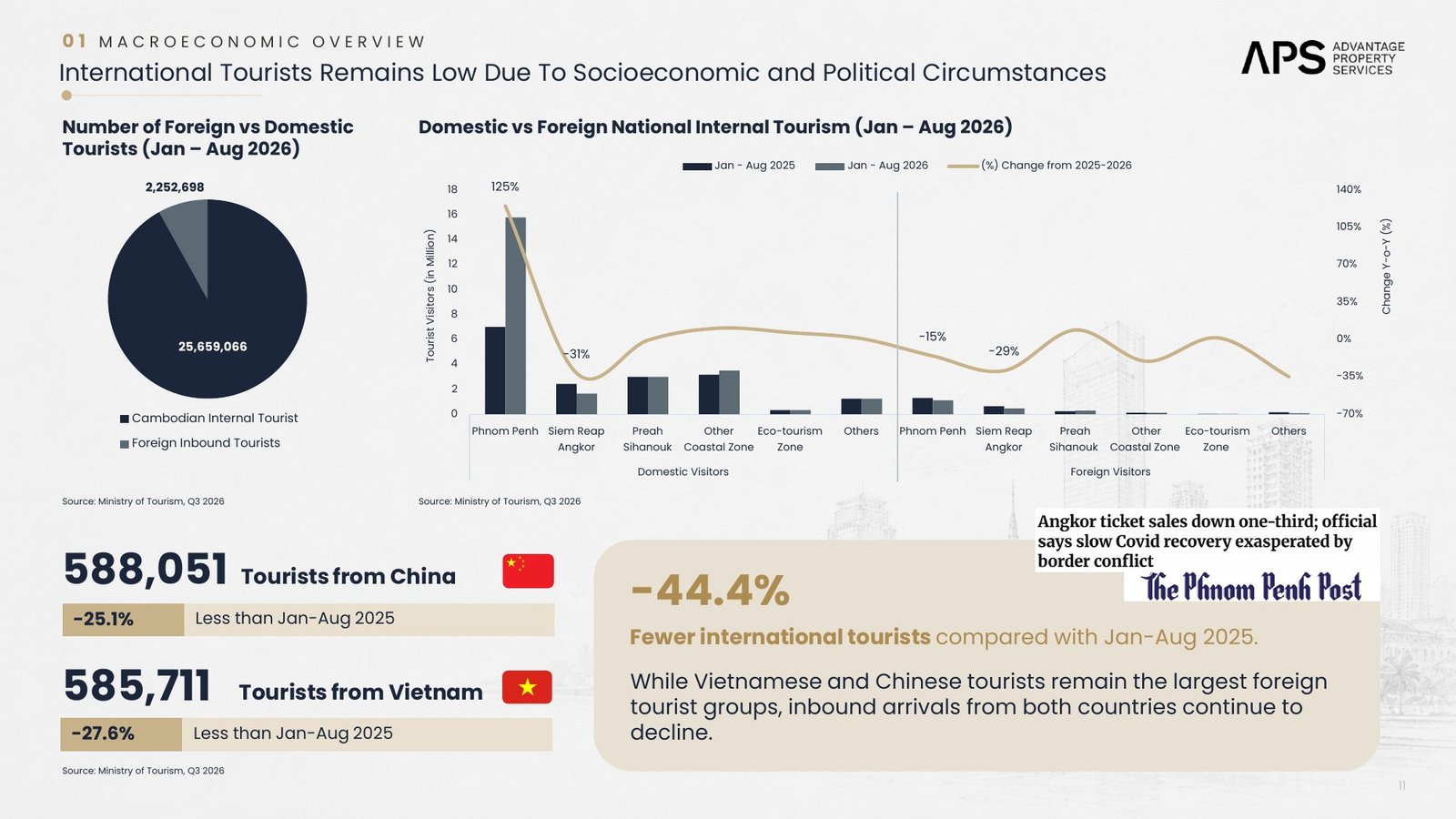
International arrivals were 2.25 million in January to August 2026, down 44.4% year on year, according to the Ministry of Tourism figures in the deck. Domestic travel generated 25.66 million internal visits over the same period. Domestic movement softens the blow to activity, but it cannot be read as a like-for-like replacement for inbound visitors.
Economic takeaway: export and investment activity provide support, but credit stress and softer household purchasing power keep the near-term housing outlook cautious.
Section 2 – Residential Market Pulse
New projects are being tailored to local budgets, while fresh completions give renters and buyers more choice. The pressure is most visible in premium pricing.
Affordable and mid-range homes still anchor launches
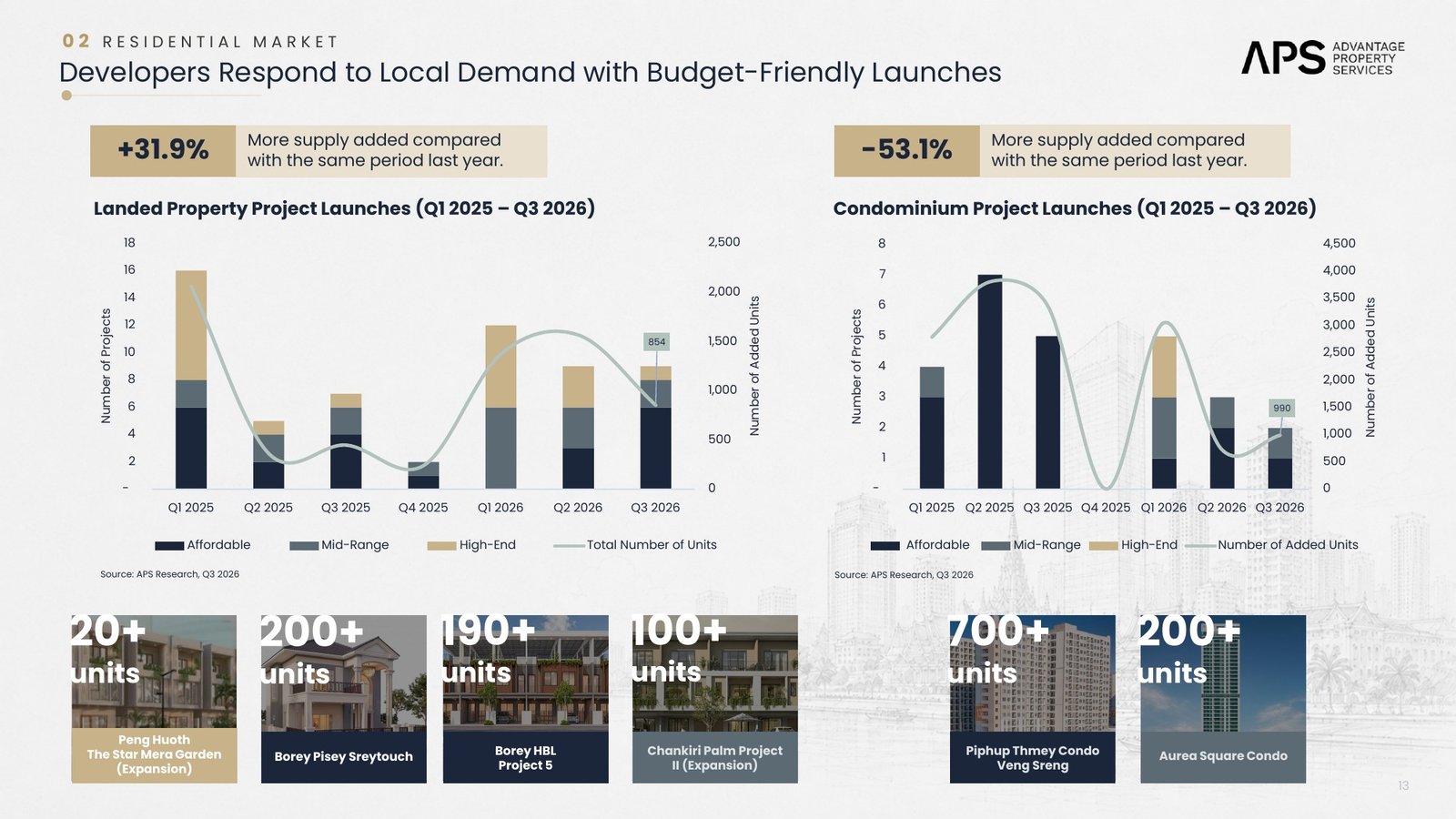
In Q3, newly launched projects added 854 landed units and 990 condominium units. Affordable products make up much of the landed launch activity, and the condo pipeline remains concentrated in affordable and mid-range schemes. The presenter linked that mix to local buyers’ budgets and payment terms rather than a return to speculative demand.
High-end projects have started to appear again, including the first luxury condo launch since 2023 noted in the presentation’s takeaways. This is a cautious test of demand: developers are releasing limited portions of projects, and the speaker stressed that established developers are better placed to enter the high-end segment.
Completions add to a crowded rental market
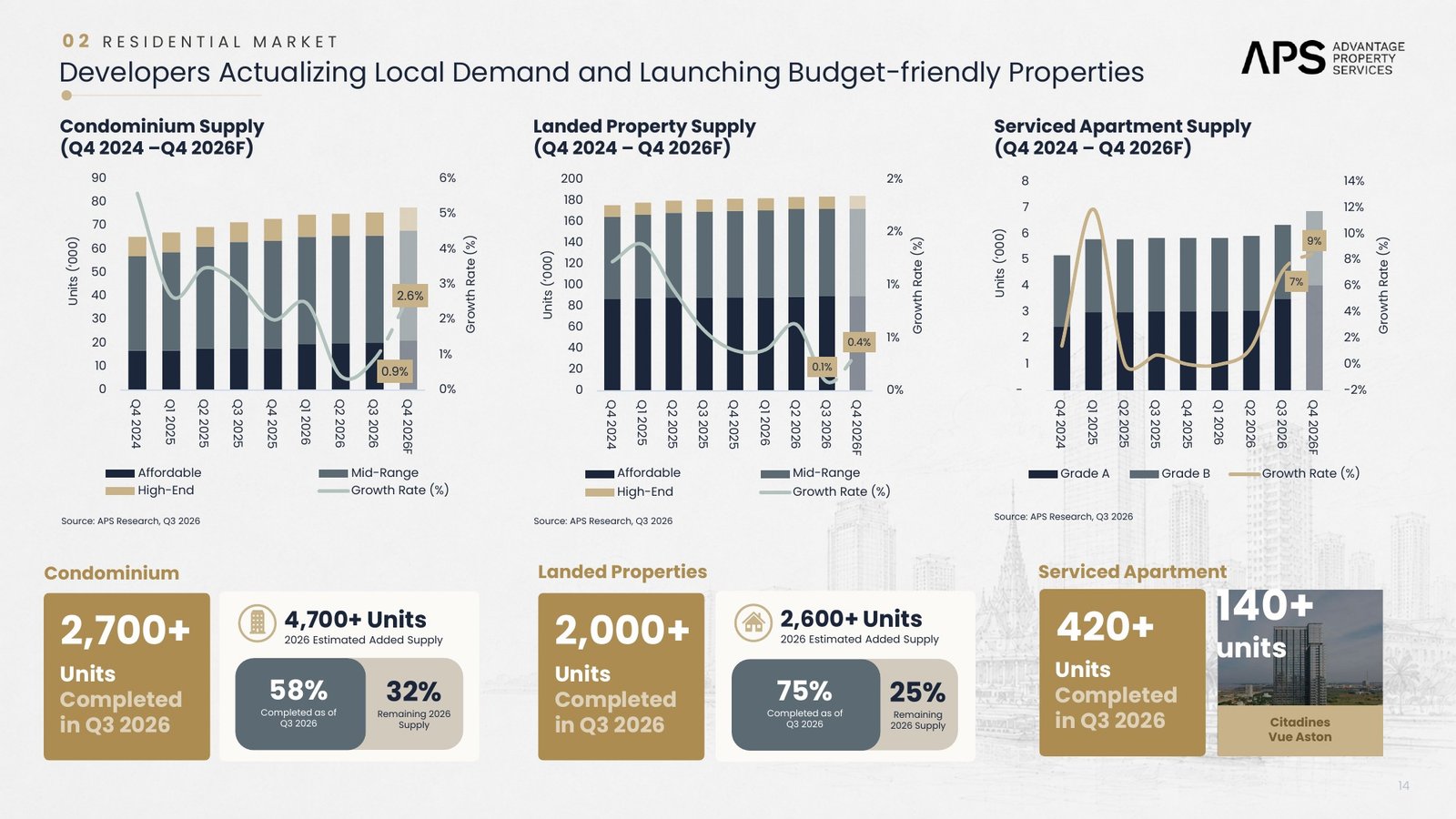
More than 2,700 condominium units were completed in Q3, with over 4,700 estimated to be added during 2026 as a whole. Landed properties added more than 2,000 units in Q3, while serviced apartments added more than 420 units. The smaller serviced-apartment base means its growth rate can look faster even though its absolute supply remains much lower than the condo and landed markets.
The webinar presenter described younger local buyers as more open to apartment living, which could support genuine end-user demand over time. Yet many completed condos also compete for tenants. The pressure from new stock therefore appears first in the rental market, particularly where a well-located mid-range condo offers an alternative to a premium apartment.
Luxury asking rents are giving way
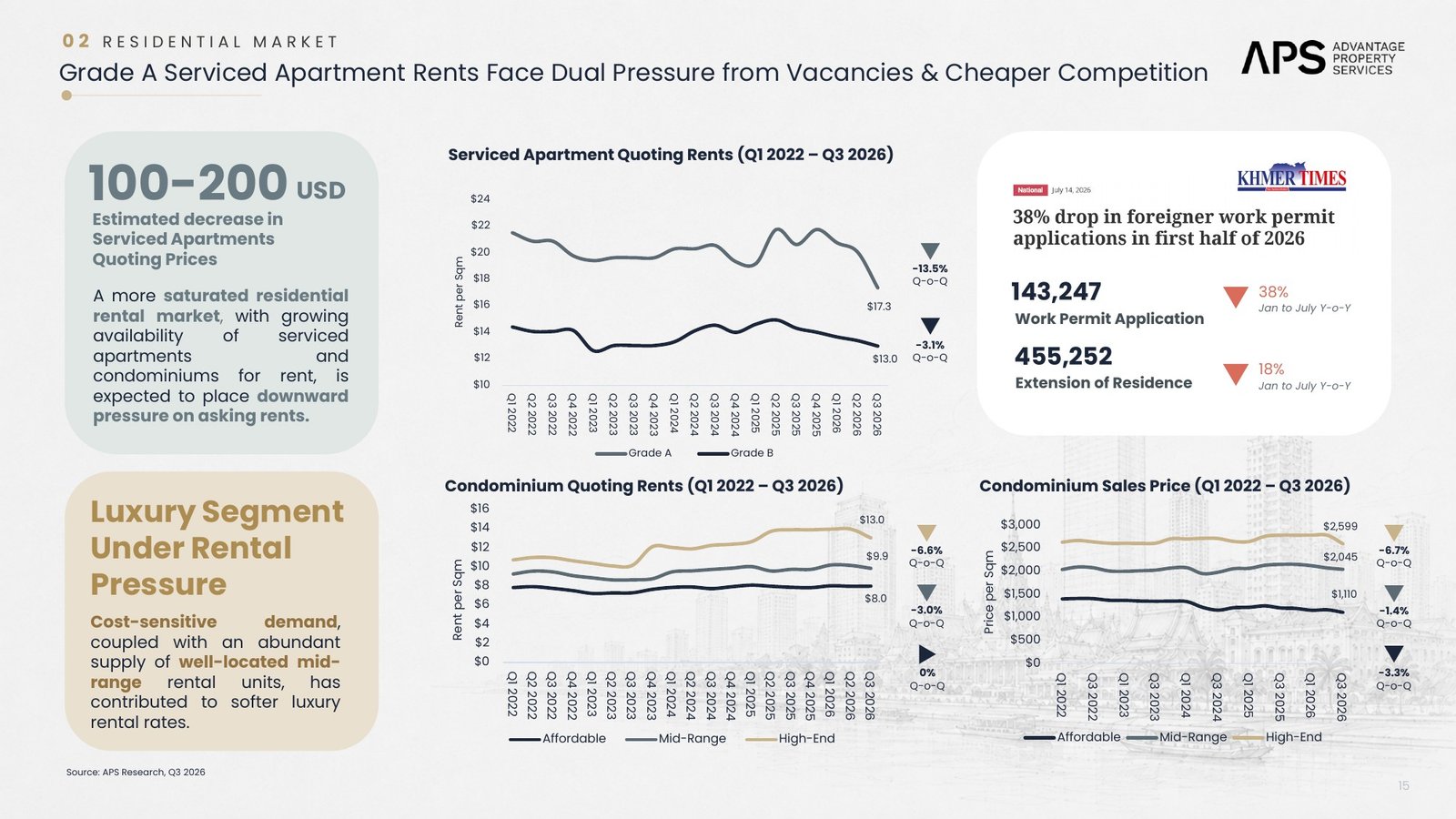
The sharpest quarterly move in the deck is in Grade A serviced apartments: average quoted rent fell 13.5% quarter on quarter to USD 17.3 per sqm per month in Q3. Grade B slipped 3.1% to USD 13.0. Cost-conscious tenants, a broader selection of rental units and competition from well-located condominiums are adding pressure.
Condo asking rents show a similar divide. High-end units averaged USD 13.0 per sqm per month, down 6.6% quarter on quarter; mid-range rents were USD 9.9, down 3.0%; affordable rents were steady at USD 8.0. The presenter suggested that the gap in location and convenience between mid-range and high-end projects has narrowed, making premium rents harder to defend.
The quoted condo sales prices on the same slide were USD 1,110 per sqm for affordable, USD 2,045 for mid-range and USD 2,599 for high-end stock. These are asking prices, not transaction prices. All three series declined quarter on quarter, with the high-end segment posting the largest fall at 6.7%.
Resale negotiations may be becoming more workable
The residential takeaway is less about a broad price rebound than about the gap between sellers and buyers narrowing. In the webinar, the presenter described owners reducing long-standing asking prices and buyers responding rather than insisting on much deeper discounts. That is a qualitative market observation, not a quantified transaction-price series, but it is a useful sign that some resale stock is finding a more realistic clearing level.
A market shaped by usable value
Cambodia enters the final quarter of 2026 with stronger exports and an active investment pipeline, alongside weaker growth forecasts and a banking system managing credit stress. Phnom Penh’s residential market is responding with more attainable launches and more flexible pricing. The clearest opportunities appear where a property meets real local budgets and use, while luxury owners and developers face a longer negotiation with the market.
Ta strona jest także dostępna w językach:
 Polski (Polish)